
When reading the flavour text of this scenario, you realize that this is probably the lowest point that your heroes will get to throughout the entire game. Having been starved and tortured for weeks in the cells under the mountain, they have nearly given up hope.
And we’re about to make it even harder for them to escape! Wohooo!
This version of Escape from Mount Gram adds tougher cards to make the second stage a lot more difficult for your stranded heroes. It also features a new boss-level enemy that is no longer optional. While not as difficult as other Nightmare quests, Mount Gram will still be tricky to overcome because you start with so few cards/resources/actions. Still, it is one of the easier Nightmare decks to beat, making for a good entry into this difficulty range.
Nightmare Escape from Mount Gram
- Found in: Escape from Mount Gram Nightmare Pack, Angmar Awakened cycle #2
- Size: 19 cards, though 4 are set aside for stage 3.
- Increase in Difficulty: Yes, though it does not make this quest on par with other Nightmare quests. The difficulty lies in your lack of gear and allies, and the encounter deck will try and steal that from you as the game goes on.
- Fixed Loopholes: The new setup prevents players from getting their heroes early on. They will need to work through their Captured deck in order to get their remaining heroes and get those additional resources each turn. The loophole with the Grey Wanderer contract is still in place though, as contracts were designed after this version of the quest, so it does not compensate for it.
- New mechanics introduced: A new version of Jailor Gornakh will steal heroes left in the Captured deck, forcing you to defeat him in order to make it out alive. There is also a bigger focus on stealing cards from your hand and having them be captured again.
- Play this scenario if: You are working on a Grey Wanderer deck; you want to see if a single hero is strong enough to make it out of this quest alive. You enjoyed the base version but found it a bit too friendly towards the players.
- Solo or multiplayer?: These jail-break scenarios are more fun with more players. You get to enjoy Secrecy for a while and will have to find all the players before moving on to the final stage. In solo, you can still enjoy this quest, though it is made more difficult if you have to face all the enemies by yourself.
- What to look out for: Lack of action advantage, you have to rescue allies and attachments, ally hate, threat increases (with a final jump up to 35 for the Southern Gate), and punishment for hand size.
New Rules

The new rules for this version of the quest mainly focus on the capture of your heroes. In a regular deck with 3 heroes, you will be allowed to pick one to start with. A random other hero is set aside facedown. Any remaining heroes are shuffled into your Captured deck. Once that deck is completely shuffled, place the set aside facedown hero on the bottom of your Captured deck. This is different from the regular version of the quest, where you would put it on top of your Captured deck. This would ensure that you’d have an extra hero by turn 2-3, but now that greatly depends on random factors, as well as the size of your Captured deck and how many encounter cards capture cards from the deck. This makes it far more difficult to get all your heroes by the end of the game, forcing you to clear more locations than you otherwise would need to.
This brings us to the new win condition introduced on this card. The players must be in control of all the heroes that they brought to the quest. No heroes can be captured underneath encounter cards or be in the Captured deck by the end of the game. The game will only end once the players control all the heroes. Heroes can still be in your discard pile if they died. This, in turn, forces you to confront the new Jailor Gornakh enemy, as he will steal heroes halfway through the game. These new rules allow the game to last a little longer, though you can get around the rules by having a very thin Captured deck or playing with fewer heroes.
New Setup

Setup remains unchanged from the original text, though some things are different than you would normally set up this game with. We have already discussed the different placement of your heroes in the Captured deck, which will delay your access to them. Another difference is that the Prison Cell location has changed to a new version. This version does not give you free cards anymore when you clear it. Instead, you now pay for it with threat. Luckily, this is optional, as not all cards might be worth paying for with threat, especially in higher player counts if everyone is stuck together.
The rest of setup is the same you start with one hero, 3 resources on that hero, 3 cards in hand, a Prison Cell with 3 cards captured underneath, and 7 cards captured underneath your stage 2B. The setup for this quest can take a while, but the Nightmare version doesn’t change the cards you have to put in your Captured deck, so that helps a lot. You are now split off from all the other players in the game and are ready to bring the first round!
Cards removed
The following cards were removed from the encounter deck to make space for the new Nightmare cards. No cards are removed from the Angmar Orcs deck, so it remains the same as the original, save for 3 enemy cards that get added into that deck to be shuffled in during stage 3.
- 4x Prison Cell – Replaced by a different version
- 3x Dungeon Guard – Replaced by Prison Guard
- 1x Jailor Gornákh – Replaced by a different version
- 2x Interrogation – Threat increase didn’t hurt too much
- 1x Goblin Tormentor – Easy enemy
- 1x Cruel Torturer – Easy enemy, just block him with heroes instead
The Quest
This quest is really defined by two different stages. The first is all about surviving with the scraps of your deck, half of which you might not even be able to play due to sphere matches that you do not have. The second part is an all-out fight to the exit while you try to rescue the final cards of your captured deck. This structure is the same as the base version but is made more difficult by higher-threat cards and a lack of freebies at the early stages of the game. You can still get some free cards with Planning Actions on Prison Guard and Prison Cell, but the random nature of that can cause your threat to increase a lot.

While your threat might seem pretty low at the beginning of the game, the encounter deck will try to have you raise it throughout the game in order to force you to engage more and more enemies. Effects like Goblin Patrol and Patrol Room will put you outside of Secrecy within a few turns, and by the end of the game, Southern Gate will force you to go to 35 threat regardless of how low you have been keeping your threat. Being able to engage enemies on your own terms during the early game will allow you to avoid unnecessary combat and can cause you to send more willpower to the quest.
During the start of the game, you will also find that your hands will grow quickly. If you are doing well, you will rescue cards faster than you are able to play them all. This is in part because you only generate one resource per round at the start, but also because you might not be able to play all the cards in your hand due to sphere matches. Unless you are playing with The Storm Comes, Narvi’s Belt, or A Good Harvest, you will not be able to play the cards so quickly. You could bring a mono-sphere deck to help mitigate this risk, but the lack of resources will still mean that you are going to have a lot of cards in your hand. This is something that the encounter deck takes advantage of. New Nightmare cards will pluck cards from your hand to capture them underneath encounter cards or will punish you for having a massive hand by raising your threat. Take this into account when building a deck for this scenario. Cheaper cards that you can play quickly will be preferable over 5-cost cards that will take a while to save up for.
Once the players have all met up and are ready to advance, shuffle the Angmar Orcs deck into the regular encounter deck. Do not forget to include the new Orc of Thaurdir card as well, as that is part of the new Angmar Orcs deck. The Southern Gate is also added to the staging area as per the usual setup, but players should now also bring out the new version of Jailor Gornakh. This one is a bit different, as he will force all players to search through their Captured deck in order to find any heroes left in there. A good thing to note here is that if you are not finding your missing heroes in your Captured deck anymore, it means that they are captured underneath a location or enemy in play. Try to remember which encounter cards captured cards from your deck, and you might be able to find your hero there. This is important since you will need to have rescued all your heroes in order to complete this scenario.

Having transitioned to this third stage, you will notice that the game will be a lot more combat-focused now that tougher enemies have been added to the encounter deck. If you were lucky, you just refreshed the encounter deck before the Angmar Orcs set was shuffled in, otherwise you will be facing a lot of enemies going forward. You now also have to deal with Gornakh, who will attack any player who rescues any number of cards. This can be a lot of additional attacks, so taking care of Gornakh will be a high priority. Try to cancel his attacks or put him in a Trap in order to reduce the risk of losing characters to his attack. He only attacks for 5, which isn’t a lot for a Nightmare Boss enemy, but the number of attacks he makes on top of the attacks made by other enemies can slow you down a lot.

The goal at this stage remains unchanged from the original. Get 16 progress on the main quest card, which allows you to travel to Southern Gate. Note that players will have to raise their threat in order to travel here, so there can be no more Secrecy shenanigans. The Southern Gate has to be cleared in order to win. However, where the quest would end at that point in the Normal scenario, in this Nightmare version, you might be forced to fight a little bit longer. The players are not able to win until all heroes have been rescued. If any player is still missing a hero, then they have to find them and rescue them in order to win. Players will likely have to fight Gornakh because of his first Forced effect that captured any heroes left in the decks. Once he is dead and the Southern Gate has been cleared, the players win the game. All in all, this is not the hardest Nightmare quest out there, but you need some solid deckbuilding skills to get a good enough portion of your deck to function without your Captured cards.
The Encounter Deck
Global

- The encounter deck is only 27 cards thick at the start of the game. Of that, only 5 cards are enemies, so you will be light on combat with a bit of luck.
- Shadow chances are relatively low, at 40%.
- Average threat is also low, though it depends a bit on the number of players in the game. It can only go up to a max of 3 threat, with an average of 0.89 threat/card.
- 6 cards in the deck will surge, so you can get through the encounter deck at a surprising speed.
- Doomed 3 is present on two treacheries. Considering that you start at a much lower threat than usual, you could run Doomed events to get ahead of the encounter deck. Note that your threat will be raised to 35 when traveling to Southern Gate.
- Immunity
- Southern Gate is immune to player card effects, and players cannot travel there until there is 16 progress on stage 3B.
Note that this analysis is done for the game’s initial setup. After the players have all passed stage 2B, a number of additional enemies are added to the encounter deck from the Angmar Orcs encounter set (including the new enemies). The balance will swing towards tougher enemies trying to stop you. The analysis also assumes a solo playthrough; hence, only 1 copy of Prison Cell is removed from the deck as it is part of setup.
Enemies
There are some new guards posted around the prison for this mode. Of note is the new enemy that will enter the encounter deck along with the Angmar Orcs encounter set during stage 3.
- Jailor Gornakh: Let’s start with the biggest enemy you’ll face during this quest, the newly revised version of Jailor Gornakh. Where the original version was somewhat optional and could be ignored in favor of killing other enemies, this version is more brutal and will have to be dealt with at some point. Because of this, decks that worked for the regular version of the quest might not fare so well against the Nightmare version. Jailor Gornakh will come into play when the players get to stage 3. When he enters the staging area, he will take any hero cards left in all the Captured decks and capture them himself. Since you were forced to put a hero on the bottom of your Captured deck during setup, there is a decent chance he will capture one of your heroes, if not more. This, in combination with the new rules, means that you will have to kill Gornakh in order to win the game. That is easier said than done. You will likely be swarmed by enemies at the same time that he enters play, so you will have to deal with them first. During this time, his 45 engagement cost will have him sit in the staging area for a long time, adding 4 threat to the total. His second Forced effect will also trigger while he is in the staging area and will attack any player who has just rescued any number of cards. This can add up to a lot of attacks made against you, as killing other enemies or clearing locations can mean several attacks per round made by him to each player. Ideally, you capture Gornakh in a trap to either lower his stats (Entangling Nets), deal constant damage to him (Poisoned Stakes), or prevent him from attacking at all (Forest Snare/Ranger Spikes). While engaged, Gornakh isn’t a pushover either. Sure, his attack of 5 might not be as high as other boss-level enemies, but the frequency at which he attacks makes up for that. He is also extremely tough, sporting 5 points of defence and 14 hitpoints. It takes 19 attack to kill him, which isn’t easy if you have not yet found your attacking allies or weapon attachments. The lack of immunity to card effects and attachments will probably be what kills Gornakh in your game. A hero like Beregond with Spear of the Citadel and Outmatched on Gornakh can quickly reduce the number of hitpoints he has. Beating Gornakh will reward you with all heroes captured by him, and he is placed in the Victory Display. Technically, you can still ignore him in this version of the quest, though all players should have found all their heroes before going to stage 3. If you can make that happen, then running for the exit is your best bet.
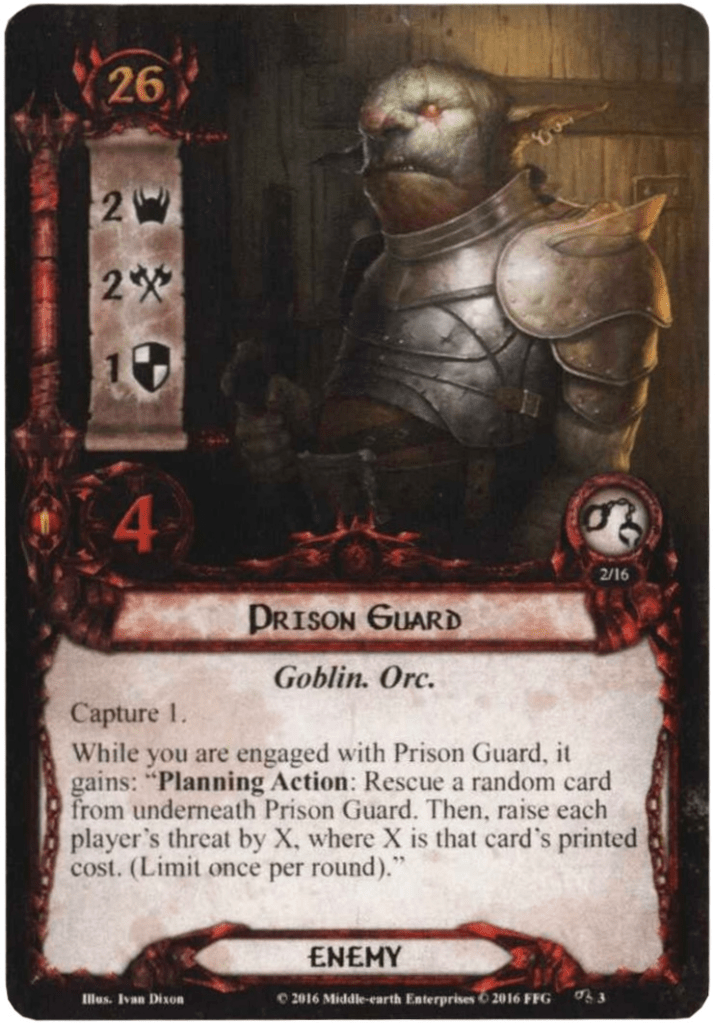
- Prison Guard: Some new guards are installed to keep you a prisoner during this Nightmare version of the quest. These have higher stats and no longer give out free cards when they are defeated. When the Guard is revealed, capture one card underneath him. You can now ignore him for a while in the early game, though with 2 attack and 1 defence, you can likely defend and attack him to chip away at his hitpoints early on. It also removes 2 threat from the staging area, which isn’t insignificant. While you are engaged with the Guard, he gains a Planning Action, which allows you to rescue a random card from underneath him. Doing so will reward you with an additional card to play, though you have to pay for it by raising each player’s threat by the cost of the card you just rescued. If there are several players at your stage, this might not be a good plan since several people have to raise their threat, and you cannot be sure which card you rescue from him. Defending the Prison Guard can be easily done by allies, though 2 attack is also the threshold where I’d consider letting the attack go undefended. This frees up your hero to attack back and do some damage. It will take 5 attack in total to kill the Prison Guard, which can take a turn or two depending on your heroes. Killing him will rescue any cards underneath him. In the late game, this enemy can mostly be ignored since other enemies are likely more dangerous here.
- Orc of Thaurdir: I have said it before, and I will say it again: don’t forget that this guy is in this version of the quest. The Orc of Thaurdir sports the encounter set icon of the Angmar Orcs set, so he does not go into the encounter deck right away. Instead, you shuffle him into the encounter deck when you transition to stage 3. It’s a good thing, too, as he is quite strong and would otherwise destroy you in the early game. With 35 engagement cost, you can guarantee that this guy will start to engage players as soon as they go to Southern Gate, or perhaps even before that if your threat is high enough. Raising his engagement cost is not a bad idea, though it will mean that you have to keep him in the staging area adding 3 threat to the total. While engaged, the Orc of Thaurdir will attack for 4. He also triggers a Forced effect whenever he attacks, where you either have to discard the top 2 cards of your Captured deck or deal him 2 additional shadow cards. Since shadow chances aren’t that high (~40%), you can get away with adding the additional shadow cards. But I also see little harm in discarding the top 2 cards of your captured deck. Since you are at stage 3, you know that there are no heroes left in there, so the worst you could discard is a useful ally or an attachment you need. Include some ways to retrieve cards from your discard pile and this choice is not that harsh anymore. Killing the Orc of Thaurdir will take some work, as he has 3 defence and 5 hitpoints, making him more resilient to direct damage effects. 8 attack is required to kill him in one go, or you have to endure him and his Forced effect for a little longer. This enemy will take priority to kill over many others just because of his higher attack and unpredictable 3 shadow cards once you run out of Captured cards to discard.
Locations
The icy tunnels of Mount Gram hold many chambers that you’d rather avoid if it can be helped. But perhaps you will find some of your equipment or friends in these cells and torture chambers.
- Prison Cell: Keep in mind that this is the new and improved version of Prison Cell, as the original version has been completely removed. This might be a bit confusing due to the same title, but that was necessary for the setup text. This new version has a slightly higher threat and will still capture one card when it is revealed. Remember that the copy that starts in play will have 2 additional cards captured underneath it because of setup. The original version gave you a free card when you traveled to it; that is gone now. The new version only has a Planning action that becomes available whenever you have Prison Cell as the active location. Players may rescue a random card from underneath Prison Cell and then raise the threat of each player at this stage by the cost of that card. The random nature of this threat increase makes it a gamble whenever you have high-cost attachments or allies in your Captured deck. Once the players start joining up, I would not recommend traveling here, as there are more pressing locations, and each player will have to raise their threat instead of the player whose card was rescued. This location is meant to give you access to some more cards in the early game, but you can largely ignore it towards the end. The only exception to this rule is when you are still missing a hero. There is a non-zero chance that a hero is captured here during the mid-to-late game, just before they would go to Gornakh. That means you will have to rescue cards here randomly or clear the location to rescue all the cards. That’s usually the better deal, as you don’t have to care about raising everyone’s threat.
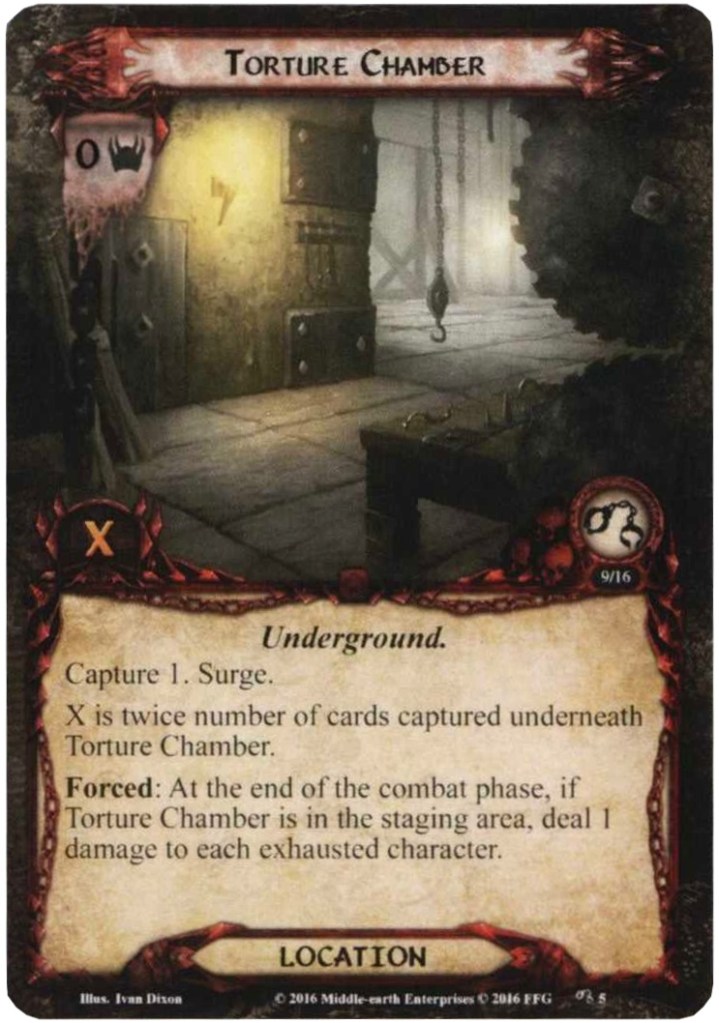
- Torture Chamber: This is a weird location, having 0 threat and no way for the location to gain more threat than the 0 it has. Instead, the quest points on this location will steadily increase, making it more difficult to clear the longer you ignore it. When revealed, the Torture Chamber will capture one card per player at the stage and surge. It now has X quest points, where X is twice the number of cards captured underneath the location. In higher-player games, this can easily start at 8 quest points, making it harder to explore. But with no threat added to the staging area by this location, why worry about it at all? Well, that’s where the Forced effect comes in. At the end of each combat phase, the players will have to deal 1 damage to each exhausted character if the Torture Chamber is in the staging area. This is the point in the round where most characters will be exhausted, and you will likely not be in a position to heal a lot of that damage in the early game. So I would say that it is reason enough to travel here since you also get to rescue the card trapped underneath the location when you clear it. You can also try to clear the location in the staging area, though that might depend on the tools you have available and the number of cards trapped underneath the Torture Chamber. Heirs of Earendil is a great card to use for this location, though it requires you to have two different characters, so it’s not a turn 1 card to play. Attachments on this location, like Thror’s Key and Woodmen’s Path, can also greatly reduce the number of quest points, potentially even clearing it without you having to travel here at all. This is not a bad location to get early on, though if you are forced to travel elsewhere, the constant damage can become annoying.
Treacheries
Two new treacheries are added to the encounter deck, and while they won’t add threat to your staging area, it will limit your progress or hurt you in other ways.
- Cruel Torment: While this is not the quest with the most Condition treacheries in the Angmar Awakened cycle, it does include one, forcing you to find a strategy to get rid of it. When Cruel Torment is revealed, it will surge and attach to the current quest. It will count as a Condition attachment that will limit your hand size to 6. If you ever have more cards in hand than 6, you must discard down to 6 again. That’s all that this does, but the additional rule does punish you for making a lot of progress all at once. Players who make 4 progress on stage 2 will get 4 cards returned to their hand. It is not unlikely that this would push them beyond 6 cards, causing them to have to discard down to 6 again. The good thing during a multiplayer game is that this only affects the player at that stage. It is even better when it hits a side-quest since you will likely be clearing that sooner than a main quest. Getting multiple copies of this treachery back-to-back also doesn’t hurt very much, as the cards will just stack but won’t do any additional harm, except for the surge. Add to it that this treachery has no shadow effect, and it becomes quite an easy Nightmare card to have to take. During stage 3, I can see that a reduced hand size will be more difficult to deal with, though, at that point, you have rescued the majority of your cards and have an easier time affording them. Have some discard pile recursion in your deck to retrieve the lost cards, and the hand size limit will be no problem.
- Goblin Patrol: This is a tricky card because it scales with how well you have been doing up to this point. The card will give you the option to voluntarily capture any number of cards from your hand underneath the main quest. During stage 2, this means that you will need to make more progress to beat the stage, essentially adding quest points to the stage. During stage 3, you will have to live with the fact that whatever cards you capture underneath the stage will be lost forever. So do that only with duplicate uniques or cards that don’t matter anymore (like secrecy cards when you are well past 20 threat). Why would you want to capture cards voluntarily? Well, that has to do with the second part of this treachery, which forces the players to raise their threat by the number of cards in their hand. If you have been doing well, rescuing cards a lot, you will likely have a pretty big hand of cards that you haven’t been able to play yet. Having to raise your threat by a lot to keep them is not going to be worth it, so having them be captured instead is going to be a good solution. During stage 2, you can still rescue the cards later, so the punishment is less severe. Have a plan for what to play in the next 1-2 turns, and have the rest be captured. This treachery should act as an incentive to play whatever cards you can in order to reduce the chance of losing those cards and reducing your hand size in the process. You can also cancel this if you want to keep all your cards and don’t want to raise your threat, but it is not a terrible treachery to hit.

Side-quests
While you shouldn’t be distracted from your goal to escape the prison, it might be worth deviating for this single new side-quest. Who knows what goodies you’ll find when raiding the vaults of the Goblins?
- Raid Golfimbul’s Vault: For those of you who know, Golfimbul was known to be a great orc chieftain from Mount Gram who invaded the Shire. His head is even more famous for being Middle-Earth’s first golf ball. He might be gone now, but his vault at Mount Gram is still here, loaded with loot for you to steal if you can find the time to clear this side-quest. When revealed, this side-quest will surge and capture three cards from the Captured deck of each player at the stage. Remember that if this side-quest appears at a player’s staging area without others having met up yet, it will only capture cards from the player at this stage, not the others. The side-quest will take 9 progress to clear, which is no small feat. It does add a Forced effect to the game, which will trigger each time a card is captured by another encounter card effect. Whenever that happens, a random card from each player’s hand (at this stage) will be captured underneath the side-quest. Since it is random, you might end up losing the ally or attachment you were hoping to play soon. On a positive note, this does drain your hand a little, making sure other effects like Goblin Patrol don’t hit so hard. But with several cards being stolen per round by this side-quest, you will want to go here as soon as you can. Once you make the 9 progress and the side-quest is cleared, you may put each rescued Item attachment into your hand. Any other attachments and all allies are instead discarded. Turns out that you can’t store Mounts in a vault for very long. Since you have to put cards underneath this quest at random, you cannot put only Item attachments underneath the quest, so you will have to clear it quickly before you end up having to discard half your deck.

Tips and Tricks
- The Grey Wanderer contract really nerfs this quest a lot. Playing this contract, you have no heroes to be captured at the start, which removes a lot of the difficulty. The setup attachment is also not affected by the setup of the quest, which can be amazing for your action advantage or lack of stats.
- The Council of the Wise contract is also really fun to try in this scenario since events are not captured at the start of the game. This allows you to get more card draw, resource acceleration, and threat reduction during the game, which makes it ideal for the early game when those things are hard to come by.
- If you focus on having a very thin Captured deck during your deckbuilding, you can also clear this quest surprisingly fast. It does require a more fine-tuned deck with fewer allies and Item/Mount/Artifact attachments. But that still leaves plenty of Conditions/Songs/Skills/Titles for you to include on top of side-quests and events.
- Choose your starting hero wisely. Have them be able to survive a while on their own. Having high willpower is a must, but ideally they also have a high attack or defence stat to kill or stall an enemy for a while. Built-in readying or healing is also nice to have for the first few rounds.
- This is really a quest where you want to make use of Secrecy. Not only because you start at a low threat but also because the discount makes your cards more affordable on a one-hero budget.
- Some of the captured cards will end up going to the discard pile. If you do not want this to happen, bring some recursion like Will of the West or Stand and Fight to your deck in order to retrieve anything you might need that got discarded. These events will be in your main deck at the start of the game, so you will always have access to them.
Playthroughs
The quest is quite popular in Nightmare mode as it is not that difficult, so there are a lot of videos to be found. Here are a couple of them that will be worth watching in order to understand the Capture mechanic and when certain triggers happen.
- True solo: https://www.youtube.com/watch?v=l4p4BeUfIEA
- True solo: https://www.youtube.com/watch?v=Eg7XlBjXKC0
- True solo, Grey Wanderer: https://www.youtube.com/watch?v=NUvPcHEdY0c
- Three players: https://www.youtube.com/watch?v=2XRnz31lYTw
Another quest done, just one more to go in order to complete the Nightmare Angmar Awakened cycle. I saved the best for last, as Nightmare Battle of Carn Dum is all that remains. I will publish this one next month, after I have take some time to move into my new house and set everything up. Until then, I hope to release the yearly review, and then pack everything up.
 Vision Of The Palantir